
Blockchain Network Introduces System That Pays Members for Link Sharing

Image Source: www.mdgadvertising.com

One of the unique features of blockchain and an attribute that makes it very appealing to a lot of communities is the incentivized technology that it offers. Getting rewarded for one’s contribution towards the achievement any given goal is the best form of motivation that there is. It does not only encourage more participation but enables the fulfillment of the intended aim of any program.

Breaking the monopoly

In its current state, the digital environment is dominated by a handful of major stakeholders who thrive on the efforts and contributions of the rest of the people. Majority of whom are left without compensation. Facebook for instance would receive all the funds from an advertiser to reach an agreed audience and number of views. These audiences who represent the actual action point, in other words the targeted resource eventually end up being used. This is what you get with centralized systems. Power, control and reward is usually monopolized by the “boss” and the people are seen as tools.

The decentralization brought by blockchain is disrupting this structure and recognising the relevance of participants within networks and communities. In the advertising industry, blockchain solution seems like “the golden pen”. Rather than the ‘hit and hope’ approach adopted by existing systems, blockchain implementation is enabling platforms to structure and execute ad campaigns with a very high precision rate.

Focusing on the actual goal

Beyond just creating and broadcasting ads, the ultimate goal of every advertiser is to reach their intended targets with content that is relevant to their needs. This is why 2Key Network is creating a platform that makes it easy for advertisers and content creators to be able to define their specific budget and also the best possible campaign execution.

The 2Key platform, that brings GRN (Global Referral Network) technology, enables a sharing network where people would share with their friends, who share with their friends, who keep sharing until the set goal of a given campaign is reached. What is important here is that everyone in the network who made a positive impact during such campaign gets paid. This creates a real network effect and a real link sharing economy that is based on the incentive model.

Cleaning up the industry

Digital advertising platforms have been criticized for a number of activities that go on within the ecosystem. For instance, the non-transparent nature of operations of the big players further emphasizes the above mentioned ‘hit and hope’ approach. This usually leaves advertisers uncertain about the actual effect of the advertising efforts. Also, on the part of the audiences, spam messages, pop-ups ads, interruptive videos and other unwanted bombardments often come across as nuisance. These elements pass as sources of resentment towards these ads, prompting audiences to find ways of blocking them. Even when they cannot be stopped, advertisements should be appealing to the audience rather than be seen to be forced down their throats.
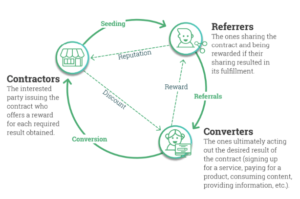
By incentivizing the act of content sharing, 2Key encourages participants to distribute valuable content. This is because the reward system within the chain will rate shared contents based on their impact and popularity. Therefore, the more a participant’s post is shared by the community, the more their rewards. Same applies to ineffective content, as they serve to reduce members ratings and their points in the long run.

Powered by Ethereum smart contract, 2Key enables the actual performance of shared content to be transparently measured. Hence, the huge waste incurred by advertisers will be drastically removed and the corruption present in the ads industry automatically eliminated.

Content sharing is about to become more profitable for everyone involved, and a more friendly advertising ecosystem introduced. Thanks to blockchain, in combination with Game theory and AI implementation.
A Finance Minister, a Harvard Alumnus Professor, and Michael Terpin are backing the Etheal healthcare project

Powered by blockchain, the Etheal.com platform allows patients to find doctors online anywhere in the world, access reviews in their own language and send inquiries immediately. The cost is a fraction of agency prices – saving American patients alone an estimated $1.98 billion per year, which would be enough to buy 700,000 CPAP machines for premature babies.

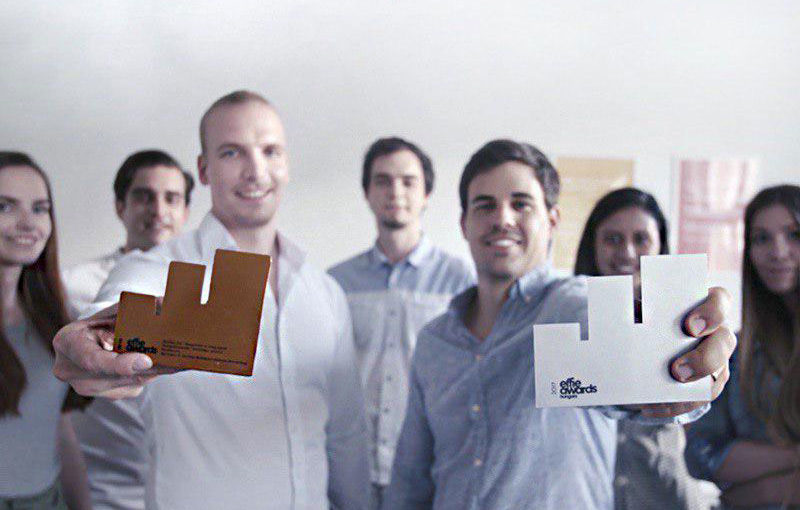
Golden Effie and Deloitte Tech Fast 50 award winning team

Lately every major newspaper from the New York Times and Forbes to Business Insider has been writing about medical tourism. They cite similar stories to that of Mr Gou’s by the Times, whose stomach tumor was not responding to chemo and radiation treatments. A trip to Boston, where he was able to access immunotherapy treatment unavailable in his native China, saved his life.

Similarly, Mr. Matthew, a Coachmag correspondent from the UK, could either suffer from a mind-numbingly painful toothache for 3 months before getting treated, or go private and pay £2,500 per dental implant. He opted instead to join the 50,000 British people who turn their toothache into a happy holiday every year. He flew to Hungary, where a dental implant costs approximately £480. In just 3 days, he cut the waiting list, received the highest quality treatment of his life, got relief from his agony, had a beautiful cultural experience, and saved a considerable amount of money.

Mayo Clinic, Cleveland Clinic and other top American hospitals are also angling for a piece of the market 

According to Fast Company, the world-famous Mayo Clinic launched a $6.5 billion plan to create the Destination Medical Center, targeting a small but incredibly wealthy segment of medical tourists. The DMC was built to win back American, European, east Asian and Gulf Arab patients who had started to opt for foreign options or domestic rivals like Baltimore’s Johns Hopkins University or the Cleveland Clinic.

So why isn’t everyone hopping on planes?

The whole thing sounds just too damn good to be true — there must be a catch. Today, between 1.5-2 million Americans travel for treatment every year. That’s the entire population of Boston, Seattle and San Francisco combined.

The problem is a lack of complete access to information, in a situation that demands a lot of trust. Medical tourism agencies help patients navigate foreign clinics and overcome language barriers. But the price to patients can be a steep 30% in commission, so in lots of the cases the middle-man earns more than the doctor performing the treatment, which in conservative estimates costs US patients abroad a total of $2 billion per year.

Medical Tourism 3.0 is on the way

Motivated by their own problems finding care abroad, the Etheal team, led by Stanford Innovative Healthcare Leader Alumnus Viktor Tabori, changing the way people access healthcare abroad.

With advisors like Michael Terpin, CEO of Transform Group, Peter Oszko, the Finance Minister of Hungary (2009-2010) and Pam Dixon, the president of the World Privacy Forum, Etheal is set on transforming the world of healthcare with a transparent global database of doctors and clinics.

Forbes reports, patients are already using cryptocurrency to pay for medical tourism services, and now Etheal is taking it to the next level. Building on their working product (https://doklist.com) that serves 2.5 million visits per year, the team has begun decentralizing public medical data to scale accessibility and reach.

Powered by blockchain, the Etheal.com platform allows patients to find doctors online anywhere in the world, access reviews in their own language and send inquiries immediately. The cost is a fraction of agency prices – saving American users alone an estimated $1.98 billion, which would be enough to buy 700,000 breathing machines for premature babies.

Etheal’s propietary tech solves medical tourism’s biggest problem: lack of trust 

Blockchain enables reviews to be translated easily, and Etheal’s proprietary Rank and Trust Score shows patients the entire history of a healthcare provider. This includes overall patient satisfaction, availability and communication, as well as quality of treatment.

Etheal’s Rank and Trust Score is modelled after the world’s largest hedge fund, Bridgewater Associates’ Believability Score. The groundbreaking paradigm is designed to rank participants based on merit, to circumvent an autocratic system ruled by gatekeepers or a democratic game of numbers. It does this by weighing votes cast in each unique category based on the individual track record, or domain expertise, of the voters themselves. In a democracy the majority decides equally, regardless of an individual’s expertise. Etheal’s system instead creates a meritocracy in voting, where the best, as determined by informed opinion, will rise to the top of the list.

Subjective, biased and fragmented data on doctors will be a thing of the past. Together, the healthcare community can create a transparent global database of providers with Etheal.com.

Helping 1 billion people around the world with Etheal’s blockchain layer

Medical tourism is just the beginning. The team plans to develop several in-house applications on the blockchain layer, including telemedicine and pharma research tools.

The roadmap also includes incentivizing developers to build third-party apps onto Etheal’s blockchain. These apps will be available in the platform app store, and can also plug into the existing payment and distribution infrastructure. By supporting the creation and mainstream adoption of real healthcare solutions with crypto, the team’s goal is to reach as many people  deprived of good care as possible.

Token sale

Etheal’s whitelist deposit period will close on the 18th of June, together with the opportunity to earn a 30% bonus. The project has a limited $10m hard cap, and has already sold $1+ million worth of HEAL tokens to 724 contributors.

Michael Terpin, David Orban and Harvard Medical School Alumnus professor Dr. Tibor Bartha, are advising the team. Etheal’s smart contract was successfully audited by Blockchainlabs New Zealand, which isn’t surprising, as co-founder and CTO Mr. Tabori lectures on smart contract security at UCIrvine and the Hong Kong Polytechnic University.

For crypto enthusiasts holding wallets full of payment, landing and gambling tokens, Etheal balances portfolios well as a top-rated ICO in the healthcare space. The team has an already working application with 2.5 million visits per year, which of course does not eliminate all the risks associated with crypto projects, but is a strong sign of credibility.

Whitelist closes on 18th of June: you can secure your spot here: https://etheal.com/

Get your personal referral code (7% reward): https://etheal.com/#personal_refcode

Contact: [email protected]

E-Commerce Disruptor SONDER Nears ICO Sellout

Since the inception of cryptocurrency, a core value among enthusiasts and evangelists in the space has been a necessity for merchant adoption. Now, nine years since the creation of Bitcoin, some merchant integration has been seen, but the technology as a whole has yet to provide a seamless method for widespread adoption among consumers and producers alike. However, the SONDER project could potentially be the key component, the link that unites blockchain with merchants throughout the world.

Conceived in the Summer of 2017, SONDER represents an evolution in e-commerce initiatives in the blockchain sphere. Currently, a number of roadblocks: high fees, slow transactions, and a lack of transparency, has previously inhibited merchants from adopting blockchain market platforms. SONDER is a custom blockchain platform that addresses each of these issues through an ecosystem that is also both secure and easy-to-use for businesses and consumers alike.

Soft cap achieved

Recently, SONDER (SNR) has hit the US$4 million mark to reach the soft cap of the ICO. The hard cap rests at $6 million, and over $5.2 million in total contributions, that cap is poised to be achieved very shortly. The SONDER team is comprised of veterans and heavyweight in business settings throughout Japan and Europe. Investors see the capabilities of the team in forging a platform that accurately meets the needs of vendors worldwide, and, more importantly, connect them in a seamless manner to the new capabilities presented by blockchain infrastructure. The global e-commerce industry is worth close to US$2 trillion. With a hard cap of just $6 million, the payoff from a successful SONDER future is monumental.

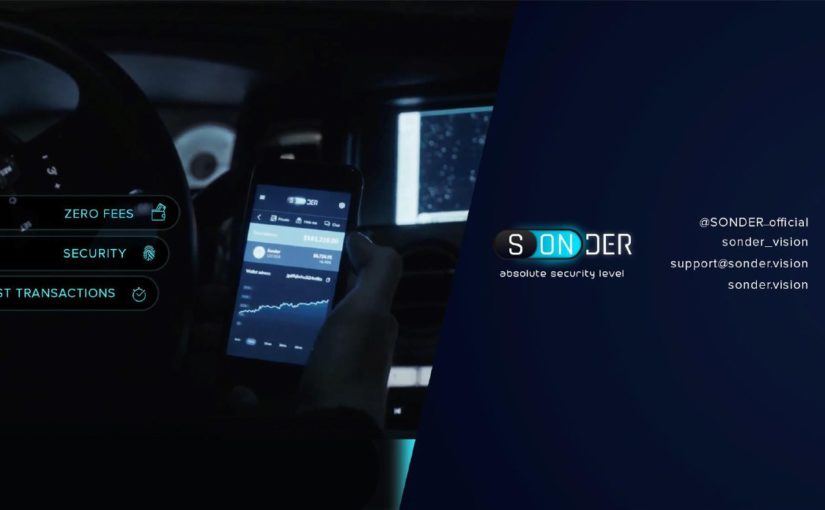
SONDER offers a whole array of benefits unmatched by existing e-commerce opportunities in the cryptocurrency space. Merchants and consumers alike benefit from a zero fee ecosystem. With SONDER’s own API and SDK, integration on and usage of the platform is as simple as possible. End-to-end encryption, secure messaging, and Tor integration ensure a completely private, untraceable, and secure experience for every participant involved.

On top of this, the platform is equipped to handle different cryptocurrencies and even fiat currencies, further expanding the inclusivity provided. The custom blockchain, with near-instant transactions, is also equipped to scale far beyond the capacities of traditional e-commerce cryptocurrencies. Holders of SNR are also incentivized through the integration of high yielding masternodes. As the platform is developed and grows, individuals with masternodes will see their balances increase alongside inevitable price increases.

The ICO is concluding shortly, and with less than US$800,000 worth of SNR for sale, its imperative to look into SONDER sooner, rather than later. The price of SNR is pegged to .00007 ETH, with 70% of the 240 million supply distributed through crowdsale. Shortly following the crowdsale, SNR will see listing with major exchanges. This is shortly followed by an Alpha launch of the platform in the third quarter of this year, with the mobile app emerging in the following quarter. In the first quarter of 2019, both masternodes and the SONDER mainnet will launch. By the second quarter of next year, the SONDER platform will be fully published, with the zero fee ecosystem open to users worldwide.

Aimedis – the e-Health ICO of the Year: Get 35% presale BONUS at BRIC INVEST now!

With the launch of the AIM token for the international eHealth platform Aimedis, investors now have the chance to earn a 35% sign-up bonus at BRIC INVEST and participate in the global boom of the eHealth revolution!

Amsterdam / Prag, 5. Juni 2018 – Aimedis is already the world’s leading eHealth platform, where patients can file and share their data, consult with doctors, renew prescriptions, and perform therapy sessions without leaving home. Based on the current success in Europe, with thousands of doctors and therapists, and tens of thousands of patients already using the platform, Aimedis is now issuing the AIM, which will be used to pay for the healthcare services offered within the platform. With this ICO, Aimedi’s global investors are sharing in three of the most innovative and dynamic developments of our time: the eHealth market; the Blockchain; and Artificial Intelligence.

Leading analysts worldwide see high profit potential in the AIM-ICO: ICObenchmark.com rated the AIM ICO with 4.6 out of 5 possible points as the currently best eHealth ICO worldwide. Also, Paymentweek.com concludes that “the AIM-ICO will be very well worthwhile for investors looking for the ‘next Bitcoin’“. Other international platforms such as Wallstreet-Online.de, BTC-Echo.de, Kryptomagazin.cz/sk/pl, Finanztreff.de etc. have also reported positively on the AIM-ICO.

To participate in the boom of the eHealth revolution, take a closer look at the AIM-ICO – the only eHealth-platform that integrates Blockchain, Artificial Intelligence and Cryptocurrencies in one profitable business model. And for the $ 36 million raised by this ICO are used to further develop and attract new users in the billion patients markets of Southeast Asia, Aimedis will soon face enough AIM-paid transactions within the system to ensure a massive increase of the value of the AIM-token.

To participate in this boom market, just order AIM at BRIC INVEST today: Only there you will get 35% in bonuses on your investment, and receive 11.25 per dollar rather than the nominal 8.33 AIM per dollar that you will get elsewhere. Buy AIM now at BRIC INVEST, and secure a profit margin of 35% even before the ICO is completed!

Futher Informationen: https://bric-holding.com/aimedis-ico-EN.html Buy AIM now: https://bric-holding.com/contact_us_en.html

Blockchain tech could power Boris Johnson’s fight to end illegal wildlife trade

Let’s be honest about things; not all the ideas that Boris Johnson supports are good ones… yes, we are looking at you ‘Brexit’.

However, every now and again he does stumble across something that could be described as innovative.

The idea to have the UK’s best tech minds battle illegal wildlife trade may actually be one of those ideas. The Foreign Secretary has called on tech whizzes to help win the battle against illegal poaching and fight the hunting of endangered animals.

He said: “I want to make sure we’re using all the great talent we have available to us to fight this problem, so I’m calling on our finest technological brains to help us in the battle to save some of the world’s most endangered species.”

The current plan is to host a series of workshops to demonstrate how technology, such as blockchain, can be used in these scenarios.

According to the official UK Government website, the goals of these workshops are to “bring experts and conservationists together to deliver technological solutions to combat poaching, make it easier to identify illegal wildlife products at borders or to spot animals in danger in the field.”

The first one of these workshops has already happened, with more planned in the near future. The first event brought together industry giants, such as Google and Amazon, to hear the challenges being faced in this area.

One of the leading names in the industry, TechUK’s CEO Julian David, was also in attendance and believes that the transparency of blockchain could be a key tool in the battle for conservation.

He said: “Whether it is blockchain to support supply chain transparency and assurance or drones, satellites and the internet of things-enabled solutions to monitor activity in national parks and areas of high scientific interest, new tech is revolutionising conservation across the world.”

Boris Johnson added that a recent trip to the Amazon has made his solidified his decision to follow through with this plan.

He added: “I’ve just come back from the Amazon, one of Earth’s natural wonders, where both animals and people are suffering at the hands of criminals who are committing horrible wildlife crimes. What I saw has only sharpened my determination to combat the blight of the illegal wildlife trade.”

OSA DC  - The Agnostic Savior of Retail Industry

Dr. Paolo Tasca, Executive Director at UCL Centre for Blockchain Technologies (CBT), Advisor on Blockchain for EU Parliament and the UN on OSA DC’s Mission to Renovate Retail.

Dr. Paolo Tasca is a Digital Economist, Blockchain Specialist and Public speaker, who specialized in peer-to-peer financial systems. In the past, he was the lead economist for digital currencies and peer-to-peer financial systems at Deutsche Bundesbank, Frankfurt. Currently, he is an advisor on blockchain technologies for a host of international organisations, including the EU Parliament and the United Nations. He is also the founder and executive director of the Centre for Blockchain Technologies (UCL CBT) at the University College London.

His seasoned career makes him an ideal advisor for blockchain development as it relates to the EU’s and UN’s policies and regulations. An invaluable asset to the team, he provides a wealth of insight into the impact of blockchain on existing industries, what OSA DC’s multi-technology platform means for retail and other industries, and what the future of shopping could look like with OSA’s decentralized solutions.


Why did you choose to join the OSA DC team as an advisor?

So basically I find that applying blockchain, artificial intelligence, and data analytics to the fast moving consumer good market is very interesting. I didn’t see any companies in the market taking OSA DC’s approach, so when they contacted me, I was very enthusiastic and I was happy to join the advisory board. It’s also a step ahead of its pees. It’s not just a whitepaper; there’s a serious team backing the project, which has already developed some milestones in the sector with the OSA Hybrid Platform. They have a strong expertise in AI, big data analytics, and blockchain, and their expertise was another strong factor to get me to join the advisory board.

I also like OSA’s combination of different technologies. The team understands something very important, something few companies and teams have understood so far in this industry. This is, the fact that you cannot treat the blockchain as the panacea to cure all the problems in the world. Rather, it is a medicine that needs to be used with other technologies to heal the system’s problems. You need artificial intelligence, machine learning, decentralized process management, image recognition technology, and so on. These are all part of the same toolbox, and I think the fact that they use this technology together is very unique — no one else is doing what they’re doing.

Do you feel that you can influence the industry on a personal level by working with the OSA DC team?

Well I hope so. I think that we are moving towards an era of real-time, high frequency data exchange between humans and Internet of Things (IoT) technology. Projections say that by 2030 there will be something like 100 billion IoT devices that we will exchange information with, so we need to collect this information somehow. The best way to do so is to give power back to citizens, to give them control over their data, and the tool do this is blockchain. So the fact that OSA decided to design their ecosystem on a blockchain platform that works with AI is very promising. The users, the consumers can decide whether they want to share, how much they want to share, and by doing so, they are rewarded, so they are actively taking part in the sharing economy. They basically take part in the production process because they help retailers and manufacturers to analyse consumer behavior and they alert them to product anomalies and risks.

Instead of having a monopolistic control, centralized control over the platform’s data — the kind of control we’ve seen over data for services like Facebook, Uber, and other centralized platforms — with OSA DC, we are creating a decentralized platform where the raw data and its use is directed by the people based on a community-driven reputation system. So bottom line, the people, the consumers are in control of the platform, and this is the major difference between OSA DC and the first wave of data management platforms that I’ve seen so far.

Do you think that the innovate technologies OSA integrates will improve the retail industry? Is it ready to accept the change?

Well yes, of course! We have a lot of data so we need to decide what we want to do with it. We have two choice. We can either ignore it and not collect it, or we can empower informational services with this data. I think the choice here is obvious, so we should go the second route by empowering ourselves with a larger informational reserve which allow us to make wiser, more intelligent decisions. Now, how we do that — that’s the tricky part. If we do it by centralizing everything and stealing information from consumers, this will not be beneficial for the consumer or the industry at large. But if we keep the consumer as an integral part of the production process, allowing them to interact directly with the producers, then this will be beneficial for all involved in the long run.

What are the key concerns you experience with the retail supply chain as a consumer?

The major concern that I have, which happens very often, is not being able to find the same product for the same brand across different stores. For instance, when I go to buy my favorite brand of buffalo mozzarella in the grocery store near my flat, it’s often out of stock on the shelf. So I have to walk more than a mile to the next shop to find the mozzarella that I want to buy, or I need to adjust my choice to find the next best brand.

So shelf stock-outs are the main problems that I see in my case. But also, you know, there’s the problem of having overly expensive prices. I find it difficult to justify some of these prices, because they cover retail market’s inefficient processes — you’re not paying for the product; you’re paying for the overhead. These are the most frustrating things that I find when I shop.

Absolutely, so something like OSA DC’s product master catalogue and its product registry and look-up would help tremendously with these problems.

Yes, absolutely.

How, in your opinion, can consumer data collection improve retail business processes?

It depends on how you handle the data. So here, OSA DC wants to use two important technologies: AI and image recognition, both for big data analytics. If you use AI, then you have a method to recognize data patterns, which enables the platform to forecast problems, such as in-store product shortages. Such problems can be detected by the AI, which can then respond to them in a timely manner. And image recognition is very useful from the consumer side of things. You enable the consumers to be able to pinpoint the products they really want, making sure that they match their expectations and diets. So if you integrated this with healthcare data, this could help consumers to make purchases based on the diet recommendations of a physician and help them to make healthier, more informed purchasing decisions.

Once you put all of this data on the blockchain, thus securing its integrity, all of this is very powerful.

Do you think it is important to encourage cooperation between each party — consumer and manufacturer, at each stage of product circulation?

Of course. Like I was saying earlier, connecting consumers to producers and retailers can only improve services, because it introduces a new level of cooperation and support. And this will help to provide value to the industry in a more holistic way, as it engages every actor involved with the industry.

What are the key innovations you believe in the most and why?

So there’s no particular technology that makes me say, “Ok, this is a breakthrough that has never been used before.” But the novelty of this ecosystem is its design and how the combination of technologies are put together and put to use. This originality has given us a very powerful platform, a very powerful tool to connect consumers to retailers, retailers to manufacturers, producers to consumers — all of the people in the supply chain are connected on a different level through this data. OSA DC connects all of them using these tools. So basically, the design of the platform is the kicker. It’s a new combination of existing technologies, not unlike blockchain itself. Blockchain is novel because it’s putting together all of these old technologies into something new. So the same for the platform here. I see this as an evolving platform that will mature over time with the help of artificial intelligence and big data analytics, so I think the combination of all these cutting edge technologies makes OSA DC truly novel in design.

How do you see the retail industry in 5 years and OSA DC’s role in it?

Yeah, so it is very difficult to predict the market. What’s interesting for me, what’s important to consider is that it is an agnostic platform. It’s a kind of research and development lab which is providing a platform which is put together in a regional fashion, and this will serve and bring power to the retail industry. But this same platform could be applied to other sectors. So I would say I think that OSA DC should be an industry agnostic platform, one that could expand to other services and industries in the future. Also, the fast moving consumer goods market has a large amount of available data, so we need to figure out how we can store, transfer, process, use, and power decisions using this data. So for retail specifically, given its first-mover advantage, I think OSA DC is well positioned in this sector, and I have high hopes for it even five years from now, especially considering I believe it can be applied to other sectors.

https://www.paolotasca.com/

OPEN 3X’s While Ethereum Goes Down the Tubes

We all know how difficult it has been to accept payments from multiple cryptocurrencies, whether it be via apps, websites, or d-apps –until now. The OPEN Blockchain platform makes it easy and that’s why it grew threefold since it went public, while Ethereum is sitting stagnant on exchanges.

Accepting In-App Cryptocurrency Payments Just Got Easier with OPEN Chain

OPEN is currently available on KuCoin exchange and supports trading in OPEN/BTC as well as OPEN/ETH. If you´re interested in making the dream of an interoperable crypto payment processing tool finally become a reality, be sure to explore (and invest in) OPEN Chain.

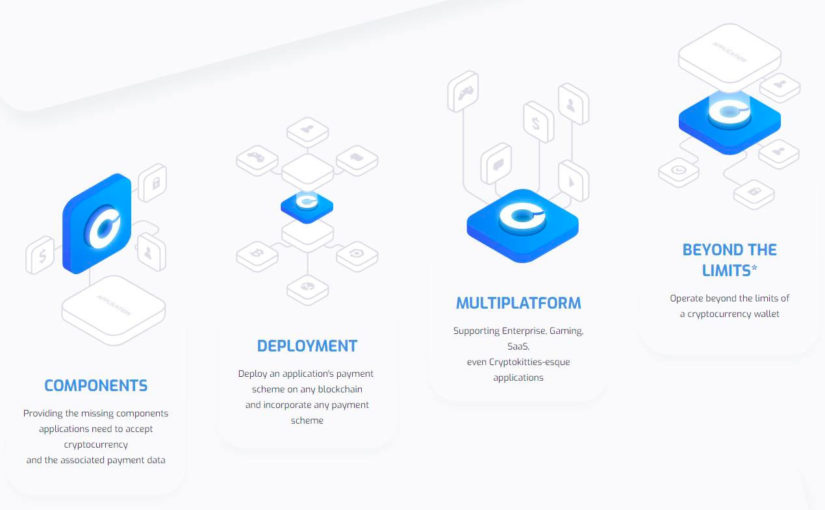
Recently the OPEN team proudly introduced the world’s first multi-cryptocurrency payment solution. It works a lot like Stripe, and is perfectly interoperable with a range of existing blockchains.

Previously this space was dominated by Ethereum. However, unlike Ethereum, the OPEN Blockchain platform can be easily implemented by e-commerce businesses, making this new technology a once in a lifetime investment opportunity.

All You Need in Order to Accept Crypto Payments Is a Few Simple Lines of Code

That’s right. And that’s why OPEN Blockchain Platform is set pick up where Ethereum fumbled; it will allow developers and sellers to support cryptocurrency payments on an unprecedented scale, all the while accepting multiple coins and running extremely fast.

The philosophy at the core of OPEN is this: to make one simple online solution that will process all the bits and pieces that go into crypto payment processing –and provide it as a single, elegant service; kind of like how Stripe has revolutionized FIAT payment processing. OPEN aspires to do the same with cryptocurrency.

Let’s take a deeper look into the idea and inner workings of OPEN now.

Who’s Backing OPEN Chain?

A few names you may recognize (from such projects such as Zilliqa, Ontology or VeChain) are presently backing OPEN: NEO, DHVC, Draper Dragon, Jeremy Gardner, Sora Ventures, RChain, and most recently Element Group.

The team behind OPEN Blockchain project no less impressive. You will find people like Roger Lim (NEO Global Capital), Lorne Lantz (Paypal Partner & Payments), Will Bunker (Match.com), John Gardiner (Facebook Messenger Apps & Games), Andrew Leung (Grindr) and Steven Zhang (backed by MaRSDD & Velocity Accelerator), among others.

Why Is OPEN Chain a Unique Proposition?

It’s clear by now that there is no use in repeating the same ideas and concepts over and over again if what we seek to achieve is a more efficient and practical payment solution.

The difference is all about the technology under the hood.

The OPEN Blockchain platform operates as a harmony of several different elements: OPEN Cluster, Scaffolds, OPEN State, as well as Blockchain Load Balancing Protocol.

It uses their Rapid Consensus mechanism, thus preserving the integrity of data and ensuring speed.

The OPEN cluster functions as an ecosystem of multiple blockchains making use of gateway applications known as Scaffolds, which then transmit data into OPEN States.

Every time a developer deploys a new blockchain, Scaffolds are added immediately to the cluster.

OPEN States link to the backend of applications where they provide a source for every piece of on-chain data transmitted through the blockchain cluster.

All data is processed on the fly and in parallel, via the Blockchain Load Balancing Protocol.

The details behind the OPEN Chain can be read in their most recent whitepaper here.

How Do These Elements Integrate?

The Rapid Consensus mechanism processes all payments on the OPEN Chain, which then sends it through the Blockchain Load Balancing Protocol to make sure it gets quickly distributed to all chains within the cluster.

Comparing the OPEN Blockchain platform to Traditional FIAT Payment Processing

There is an increasingly large demand worldwide for a cryptocurrency payment processing solution that would work as smoothly as traditional FIAT systems, while handling multiple cryptocurrencies, yet without having any centralized governing authority built into it. This is where OPEN comes in.

The simplicity for developers and how it feels for consumers who use OPEN are quite similar to those of Stripe.

Likewise, it is very simple to implement it on apps, d-apps, websites, e-commerce shops and other platforms. The cost-effectiveness of the system is second to none. Also, it has traceability in common with traditional payment methods, meaning that payments can be tied and tracked back to users, and account funds are verified before processing payments.

It works for both single purchases as well as subscriptions, and has support for shipping logic and various metrics is also possible to incorporate.

Larger businesses will appreciate the OPEN API, which will allow them to implement changes on an app-wide level, thus eliminating the inherent risks of new technology.

On the other hand, developers of highly popular apps and games will no longer be dependent on the existing payment solutions baked into app stores like those owned by Apple and Google.

Most importantly, for the ordinary user, the experience will be much like what they´re already used to –except for the sky-high processing fees typically attached by third parties (PayPal, anyone?).

This will allow developers of new crypto-ready apps (at any skill level) to start developing their apps with no more fear of the complications related to payments and support.

What Do You Think?

A decade after Bitcoin, it seems the world continues using traditional payment methods.

Users of all blockchains are particularly fond of the speed it allows, both for businesses and customers alike.

Hard forks –that were meant to speed up existing blockchains— and decreasing public trust have caused entire coins (including large capital stores) to fold.

There is definitely a problem with most mainstream coins; this is where OPEN can step in to help.

Don´t Miss This Investment Opportunity

Taking in the lessons learned from existing blockchains – Ethereum being too narrow, Bitcoin too slow – OPEN has set out to allow supporters around the world to finally get their foot in the door, and into the game. They do this by providing unprecedented speed, scalability, and wide-ranging cryptocurrency adoption.

The team behind OPEN have made it no secret that major announcements are coming very soon – and certainly, those who get on board early on will have significantly higher margins, as well as a strategic advantage.

If you believe OPEN to be the next big thing (which it is!), then definitely check it out: it´s available currently at KuCoin Exchange. OPEN/BTC and OPEN/ETH trading pairs are supported.

Being its first official listing partner, KuCoin is helping the OPEN Blockchain platform provide new investors with a hunger for innovation the same kind of once-in-a-lifetime chance they may have missed with Bitcoin.

LocalCoinSwap confirm that unsold tokens WILL be burned on June 15th

With just over a week remaining before the end of the LocalCoinSwap ICO, Chief Operating Officer, Daniel Worsley, has confirmed that any of the ICO allocation of tokens not sold, will be destroyed.

“The ICO end date is final. Because our token-holders are our owners, we are wholly committed to burn any which go unsold, in order to protect the investment of existing LCS Cryptoshare funders” Worsley said.

“Whilst we are in negotiation with exchanges as we speak, we know that many of our investors are in this for the long haul, determined to hold on to their Cryptoshares in anticipation of the dividend payments which start early in 2019. Therefore whilst secondary market trading will open up the opportunity to buy Cryptoshares to those geographically constrained from ICO purchasing, we do anticipate a limited availability.”

With over $10m raised so far and the third stage of the token sale well underway, the team have their eyes focused on the future for the community. Complete transparency has always been the driving principle at LocalCoinSwap, and as the team count down the final days of their initial coin offering, they are totally clear about their future direction.

LocalCoinSwap will provide interlinked trading and communication tools to provide the greatest possible range of ways to buy and sell cryptocurrencies on a peer-to-peer basis.

“We want our users to have freedom to choose”, explains CTO Nathan Worsely. “They’ll be able to make deals in any currency, in any location. We’ll offer a choice of simple margin pricing, or the ability to use advanced formulae. And the social community tools are embedded in the platform by design, not bolted-on afterwards – every user will be able interact in the forum and build their own profile and reputation”.

With over 5500 unique users signed up and awaiting the platform launch in August, the community – many of whom are already actively engaged on a range of social media platforms  – are eager to get trading, and see the exchange come to life. And many have a vested interest in this, because LCS Cryptoshares come with additional benefits:

“We remain the only exchange which distributes 100% of profits back to its token holders,” Worsley explains, “and this shared ownership means that we all grow and develop as the exchange itself does.  For us, this underpins a fundamental value of accessibility, making the buying and selling of cryptocurrencies easy, safe and sociable – so that more and more people are encouraged to join us in this economic revolution”.

You still have time to take part in the ICO, which closes June 15th.

https://www.localcoinswap.com/index.html to find out more.


Hybrid Blockchain: The Best of Both Chains

A Google search with the words ‘hybrid blockchain’ yields roughly 756,000 search results. This isn’t many, when compared to ‘public blockchain’s’ 40 million search results or ‘private blockchain’s’ 30 million.

This article will provide an introduction to hybrid blockchain and highlight why it may become the blockchain of choice for governments, financial institutions and larger multinational organizations.

As a starting point, it is important to acknowledge that one of the core elements that make up blockchain actually came from a hybrid solution for digital time stamping of documents – decentralised hash verification.

Public Blockchains Decentralised Verification + Timestamping – The Genesis

I recently attended the Blockchain Economy World Tour in Sydney where Dr W.Scott Stornetta, presented his ‘aha’ moment in developing digital timestamping, one of the core components of bitcoin.

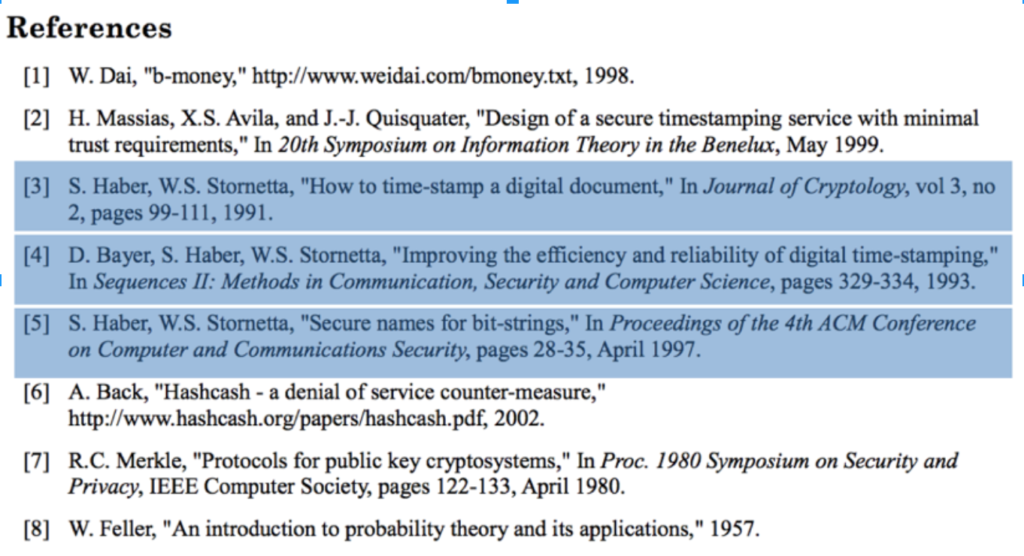
For those of you not familiar with Digital Time Stamping, it was developed back in 1991 by Stuart Haber and W.Scott Stornetta, who is the Chief Scientist for First Digital Capital. Their work on digital time stamping was referenced three times in Satoshi Nakamoto’s white paper on Bitcoin:

In Scott’s presentation he referred to his ‘aha’ moment as “letting the world become your witness”. He went on to explain that if you are not sure who to trust in a centralised controlled environment then the best protection would be to invite the public at large to verify that this transaction took place.

This decentralised public verification and timestamping of a generated hash is one of the core components of bitcoin and blockchain.

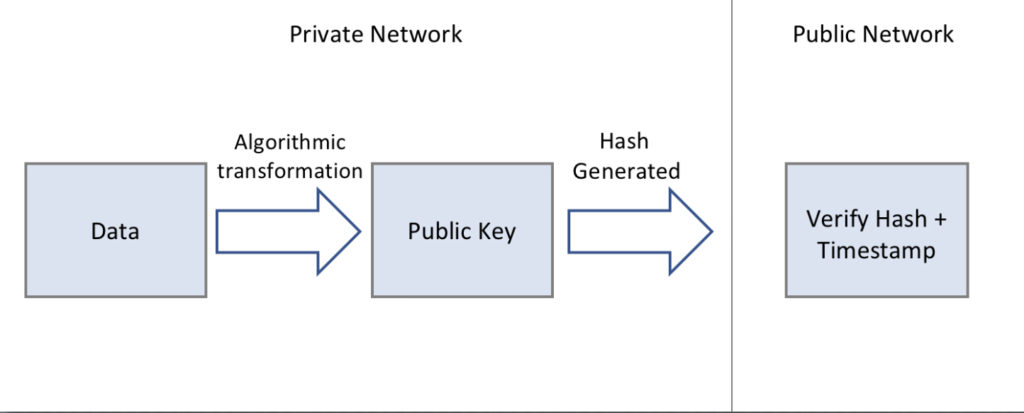
Another key observation regarding Dr. Stornetta’s work is that public verification was used to publicly verify a hash that was generated on a private network. It was 1991, and his work pre-dated the development of blockchain.

Satoshi Nakamoto incorporated decentralised public verification into a decentralised currency, bitcoin. Subsequently, most of the blockchains that have followed bitcoin have also focused on building atop of a public blockchain.

This raises the question:

Does a hash need to be generated on the public blockchain, or can it be generated on a private blockchain while using a public counterpart exclusively for verification?

Enter Hybrid Blockchain.

Hybrid blockchain offers the benefits of both public blockchain and private blockchain.

Firstly, hybrid blockchain consists of the public blockchain (that all participants are a part of) and a private network (also referred to as a permissioned network) that restricts participation to those invited by a centralised body.

Secondly, this private network generates the record (hash) of transactions which is stored and verified on the public blockchain.

The benefits of the private blockchain include faster transaction speeds, privacy of the data/ content and a centralised control over providing access to the blockchain.

Hybrid provides an enterprise-ready blockchain solution that is much better suited to highly regulated enterprises and governments as it enables them to have the flexibility and control over what data is kept private versus shared on a public ledger. Coupled with the operational needs of faster transaction times, security and auditability features that are not suited to public blockchains.

Large enterprises want the benefits that blockchain can deliver without the associated risks of a public blockchain. Especially as blockchain is still nascent and evolving.

This enterprise-need for a suitable blockchain solution has resulted in creation of several private-public blockchain focused projects including R3 Consortium, Hyperledger and the Enterprise Ethereum Alliance.

In a Fortune article published in February, 2017, we can already see acknowledgement of the benefits of embracing a hybrid blockchain by Bank of New York Mellon.

“That interconnection of public and private chains actually creates a very strong network,” Batlin said on a call with Fortune. “Each chain strengthens the other at an exponential level.” Alex Batlin, blockchain lead at Bank of New York Mellon


Current Hybrid Blockchains:

XinFin [ XDCE ]

Launched in 2017, XinFin completed their ICO in March, 2018 after successfully launching their first dApp, TradeFinex — a global trade and finance platform.

XinFin is the first hybrid blockchain and currently the only hybrid blockchain. It is built on both Ethereum, a public blockchain, and Quorum, a private blockchain. Quorum is an enterprise-focused version of Ethereum developed by J.P. Morgan of the Enterprise Ethereum Alliance.

Their hybrid network runs on a delegated proof-of-stake consensus (DPOS) between trusted master nodes with both smart contracts and IoT atop of the protocol. This allows real time data to be uploaded on blockchain.

It is still early days for XinFin yet they have completed over a dozen pilots across supply chain logistics, aviation, HR, payroll, international trade and finance settlements.

Ramco Systems, a global $1 billion enterprise software company, partnered with XinFin to provide their hybrid blockchain solutions for their clients to implement a supply chain logistic blockchain.

Ripple [ XRP ] Are they heading in the direction of hybrid blockchain?

Launched in 2012, Ripple is currently ranked 3rd by market cap on Coinmarketcap website with $30B valuation.

Ripple’s focus is to connect banks, payment providers and digital asset exchanges to process and provide liquidity for payments via RippleNet, a private blockchain variant.

Stefan Thomas, CTO Ripple & co-creator of Interledger payment protocol, published an article on Dec 26th 2017 in “The Death of The ICO” (and 4 other predictions). One of his five predictions was ‘The Birth of Hybrid Blockchains”:

“Until now we’ve seen a proliferation of both public blockchains like bitcoin and private blockchains like Hyperledger Fabric. Going forward, I think we’ll start to see the rise of hybrid blockchains, which combine the best of both worlds.”

In July the same year, Shivdeep Dhaliwal published an article in from his email communications with Marcus Treacher, Ripples Global Head of Strategic Accounts.

“Banks Need ‘Hybrid Approach to Blockchain Technology’: Ripple’s Marcus Treacher”,

Are Stefan Thomas and Marcus Treacher’s predictions of hybrid blockchains a hint that Ripple may offering a hybrid blockchain solution to their clients in the near future?

Dr W. Scott Stornetta’s work from 1991–1997 predated blockchain and is based on the premise that a generated hash from a private network needs decentralised public verification. This by definition is hybrid blockchain.
Private networks provide the first small step for enterprise to embrace blockchain technology. Hybrid provides them the next step without losing the benefits of private networks.

Stefan Thomas’ predictions for hybrid blockchain adoption are becoming a reality.

Ubanx Announces the First Blockchain Retail Platform with Physical Location – Ubanx

Ubanx bridges the gap between a mainstream audience and the blockchain world.

During the Money Summit conference, Pablo Orlando, Ubanx’ President & Chairman, announced the world’s first one-stop blockchain place offering an easy onboarding to blockchain technologies. The company plans to open a network of retail stores, known as Ubanx Spaces, where the public will access a curated selection of the best blockchain products and financial services.

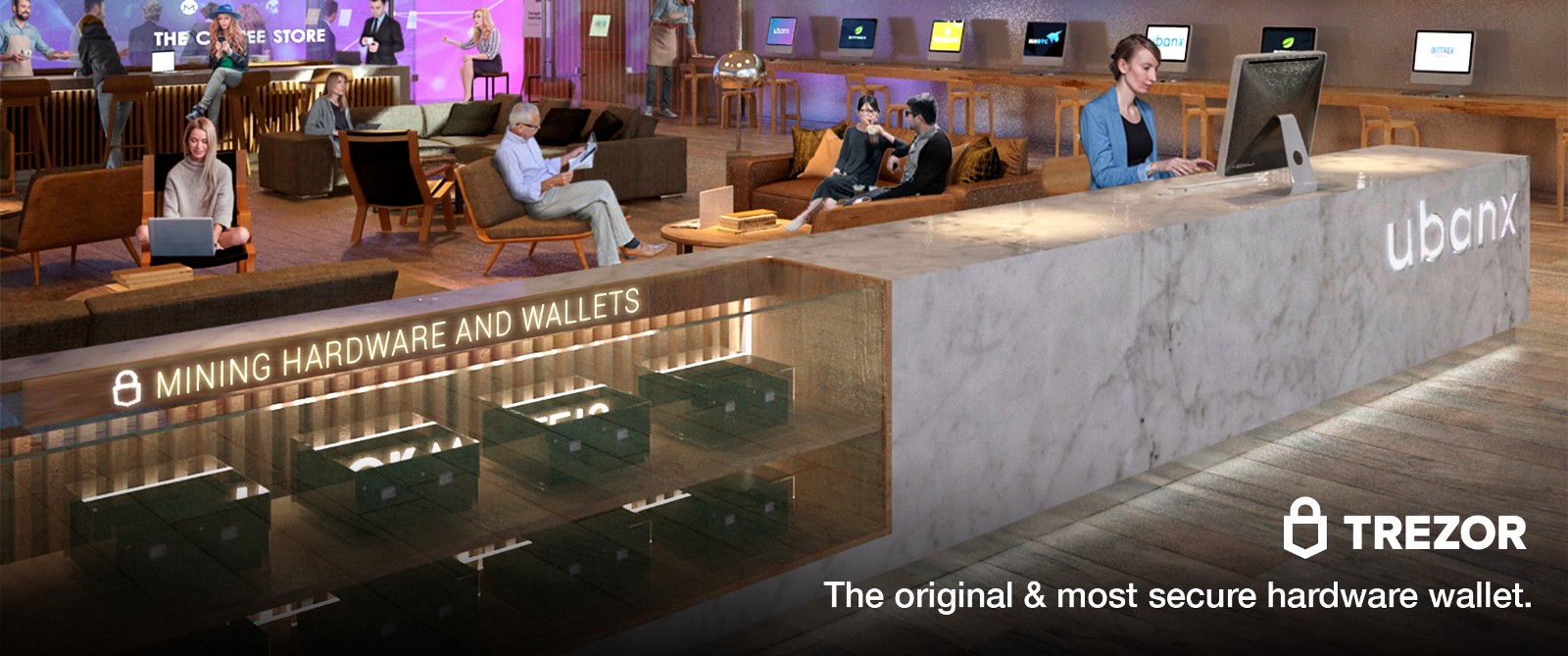
Ubanx Space concept store

Ubanx connects a mainstream audience to the blockchain world, ensuring friendly, secure, frictionless and compliant experiences. Via strategic partnerships, Ubanx will provide a one-of-a-kind blockchain experience. Partners will provide market-ready, proven solutions to integrate into the Ubanx value proposition, including: hardware wallet providers, education institutions, frequent flyer programs, co-working spaces and exchanges just to name a few.

BANX token holders can enjoy the following benefits, along with using a cryptocurrency as money to be spent or exchanged:

  • Your First Blockchain Account, easily buy or sell cryptocurrencies, and access the best financial services on blockchain, such as P2P lending or remittance.
  • Access to PriorityPass, the world’s largest independent airport lounge access program.
  • In-Store Retail Products, at the Spaces customers will find a selection of the best blockchain hardware equipment, including trading terminals, mining equipment, and hardware wallets in partnership with Trezor™
  • Ubanx Express Locations and ATMs, a network of Pop-up Spaces, featuring the essential infrastructure to onboard customers. Operated by third parties like shopping malls or co-working spaces.
  • Ubanx University, a place where the community will get an approach to the blockchain through training and courses in a seamless and secure way.
Shop Trezor hardware wallets on a Ubanx Space

Firstly, Ubanx will open exclusive flagship stores, called Ubanx Spaces, in key cities around the world, where local customers can learn and access the latest developments in financial services and instruments. Similar to the perks that are common at most co-working spaces, Ubanx Spaces will provide free private meeting rooms for customers, an auditorium for meet-ups and startup-related presentations, and an amazing support team made up of fintech and blockchain experts.

In addition, with the BANX token as a medium, the Community will be able to operate a Ubanx Space via Ubanx RTOs (Right to Operate). They will participate in auctions -run in BANX- for exclusive rights to operate Spaces in their locations, and receiving the help they need from the Ubanx HQ Team while running them.

Furthermore, Ubanx plans to launch an incubator, Ubanx Accelerator, to work with the Ubanx’ community to encourage customers to start their own blockchain-based businesses. Customers that join the Ubanx Accelerator will benefit from the company’s network of partners while Ubanx will invest in the top projects.

Key dates include: BANX Token Presale starts on April 17th 2018 and ends when all tokens are sold or on May 31st 2018. Public Token Sale starts one week after Presale and lasts 2 months.

About Ubanx

The first blockchain retail place. By deploying a network of prime brick-and-mortar locations, Ubanx connects the mainstream audience to the best blockchain financial products in the industry. Ubanx is launching a Token Sale to issue tokens, called BANX, during the Presale and the Public Token Sale.

Learn more about Ubanx on its official site.

Find Ubanx on Facebook

Follow Ubanx on Twitter

Contact Ubanx on Telegram